Saint Pope St Clement I
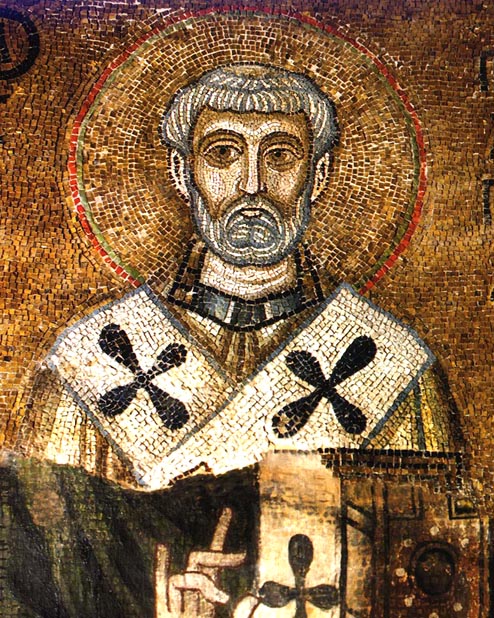
"Let us cling to the faithful who maintain the peace of the Church, not to those who hypocritically profess peace but really make war." (From St. Clement's Letter to the Corinthians)
The Fourth Bishop of RomePope Saint Clement I holds a distinguished place in Catholic tradition as the fourth Bishop of Rome, serving after Saints Peter, Linus, and Anacletus. His papacy, spanning approximately 88-99 AD, came during a pivotal period when the Church was transitioning from its apostolic foundations to establishing enduring structures that would guide the faithful through centuries to come. As one of the earliest successors to Saint Peter, Clement played a crucial role in shaping the emerging traditions of ecclesial governance and authority.
A Disciple of the ApostlesWhat sets Clement apart in Catholic veneration is his direct connection to the apostolic age. According to ancient tradition, he personally knew Saints Peter and Paul and was ordained by Peter himself. Saint Irenaeus, writing in the second century, identified Clement as one who had "seen the blessed Apostles and conversed with them, and had the preaching of the Apostles still ringing in his ears and their tradition before his eyes."
This apostolic pedigree is precious to Catholic understanding, as it represents the living transmission of Christ's teaching through those personally formed by His first disciples. Through Clement, we catch a glimpse of how the early Church understood and applied the deposit of faith entrusted to it by Jesus Himself.
The First Papal DocumentSaint Clement's greatest legacy is his Letter to the Corinthians (c. 96 AD), considered the earliest authentic papal document outside the New Testament canon. This remarkable epistle was written to address a schism in the Corinthian church, where younger members had deposed their rightful leaders. With paternal authority, Clement intervened to restore order and unity.
What makes this letter remarkable is not only its antiquity but also its demonstration of papal authority. Though Rome was distant from Corinth, Clement did not hesitate to exercise his jurisdiction over this troubled community. He wrote not merely as an advisor but as one with legitimate authority to correct and guide.
The Letter to the Corinthians reveals several principles that would become hallmarks of Catholic ecclesiology:
The importance of apostolic succession in Church governance The hierarchical structure of ordained ministry The obligation of obedience to legitimate Church authorities The value of liturgical order and dignity in worshipIn addressing the Corinthian situation, Clement appealed to the example of military discipline, where each soldier knows his place and function. This analogy established an early understanding of the Church as an ordered society with different roles, all contributing to the common good under legitimate authority.
Defender of Apostolic SuccessionThroughout his letter, Clement emphasized that the Church's leaders received their authority not through self-appointment but through orderly succession from the apostles, who themselves were commissioned by Christ. He wrote:
"The apostles received the Gospel for us from the Lord Jesus Christ; Jesus the Christ was sent from God. Thus Christ is from God, and the apostles from Christ. Both of these arrangements, therefore, came about from the will of God in good order."
This clear articulation of apostolic succession represents one of the earliest and most explicit defenses of the principle that continues to define Catholic understanding of legitimate Church authority. When Catholics today speak of the unbroken line of episcopal authority extending from the apostles, they are echoing Clement's foundational teaching.
The Liturgical ReformerTradition attributes to Clement several important liturgical developments:
Introduction of the phrase "For ever and ever, Amen" into the liturgical prayer Establishment of the sequence of liturgical prayers Organization of responsibilities for different orders of clergyWhile historical details remain limited, these attributions reflect the Catholic understanding that the liturgy developed organically under papal guidance from the earliest days of the Church. Clement's concern for proper worship speaks to the Catholic principle that authentic faith is expressed through reverent, ordered celebration of the sacred mysteries.
Martyrdom and VenerationAccording to tradition, Clement was martyred during the reign of Emperor Trajan. The dramatic account of his death states that he was exiled to Crimea, where he was forced to work in marble quarries. After converting many locals to Christianity and miraculously providing water for thirsty workers, he was executed by being thrown into the Black Sea with an anchor tied around his neck.
While modern historians debate the historical accuracy of these details, the Church has long venerated Clement as a martyr who gave his life for the faith. His feast day is celebrated on November 23rd, and numerous churches throughout the world bear his name.
Remarkable Archaeological DiscoveryIn 1861, a remarkable archaeological discovery brought Clement's memory vividly back to life. Excavations beneath the Basilica of San Clemente in Rome revealed a fourth-century church built over what is believed to be Clement's original house church. This extraordinary find, with layers of Christian history literally built one upon another, serves as a physical representation of the unbroken tradition connecting modern Catholicism to its apostolic roots.
The Basilica of San Clemente stands today as a powerful testament to Clement's enduring legacy and the continuity of the faith he helped establish. Pilgrims who visit this sacred site can trace the physical journey of the Church through the centuries, from the humble house church of the first century to the magnificent basilica that now stands above it.
Guardian of the Apostolic DepositPerhaps Clement's greatest contribution was his role in preserving and transmitting apostolic teaching during a crucial transitional period. As the generation of eyewitnesses to Christ was passing away, Clement ensured that their testimony and teaching would be faithfully handed on to future generations.
His letter demonstrates remarkable familiarity with apostolic teaching, including what would later be recognized as New Testament writings. The Christology, ecclesiology, and moral instruction reflected in his writing reveal a Church already formed in its essential doctrines and practices—a powerful counter to those who might claim that Catholic beliefs developed late or were imposed artificially.
Promoter of Christian UnityAt the heart of Clement's intervention in Corinth was his passion for Church unity. He understood that schism and division contradict Christ's will for His followers. His letter eloquently reminds the faithful that legitimate diversity must always be balanced with essential unity:
"Why do we tear apart and divide the Body of Christ? Why do we revolt against our own body? Have we reached such a level of insanity that we forget that we are members of one another?"
This concern for unity under legitimate authority continues to animate Catholic understanding of the Church's nature and mission. In an age when Christianity faces countless divisions, Clement's witness reminds us of the importance of maintaining communion with the successor of Peter.
ConclusionPope Saint Clement I stands as a luminous figure at the dawn of Christian history, bridging the apostolic age to the developing Church that would spread throughout the world. His clear teaching on apostolic succession, liturgical order, and ecclesial unity provided a foundation upon which Catholic tradition would build for centuries to come.
In venerating Saint Clement, Catholics celebrate not only his individual holiness but also the divine providence that guided the early Church through its formative period. His papacy reminds us that the essential elements of Catholic faith and practice were not late innovations but were present from the beginning in the teaching and structure established by Christ and the apostles.
As we face the challenges of living our faith in the modern world, Pope Saint Clement I invites us to remain steadfast in preserving the unity of the Church and the faith handed down to us through the centuries—a faith that has survived persecutions, schisms, and cultural changes because it rests on the solid foundation of apostolic authority.
"Let us fix our eyes on the blood of Christ, and understand how precious it is to his Father, because, being poured out for our salvation, it has brought to the whole world the grace of repentance." (From St. Clement's Letter to the Corinthians)
Please or Login to leave Comments